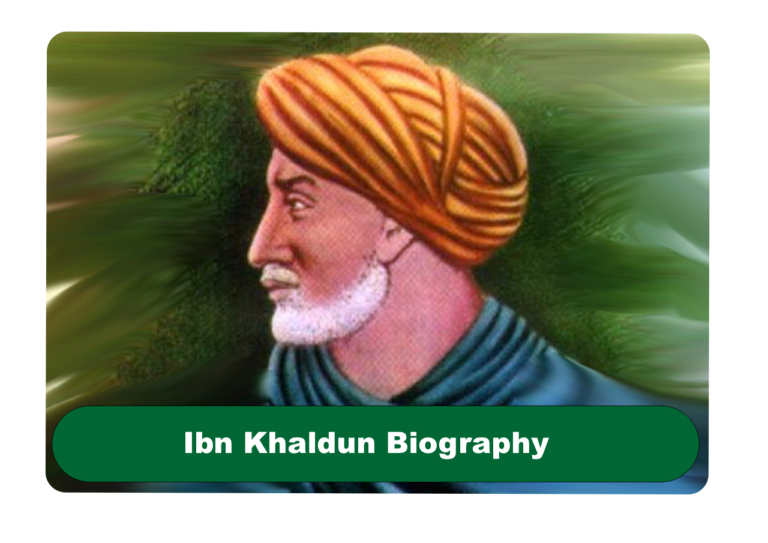
Discover Ibn Khaldun’s biography, age at death (73), family, works and legacy. Learn how his Muqaddimah transformed the study of history and human society.
Ibn Khaldun was a 14th-century Arab historian, philosopher, political thinker, and scholar widely recognised as a pioneer of sociology and modern historiography. Born in Tunis in 1332, he developed groundbreaking ideas about how societies function, how governments rise and fall, and why civilisations change over time. This Ibn Khaldun biography explores his early life, education, family, political career, famous books, and lasting contributions to social science.
His most influential work, the Muqaddimah, introduced an approach to studying history through social organisation, economics, politics, and human behaviour. Unlike many historians of his time, Ibn Khaldun examined the underlying causes of historical events rather than simply recording them. His theories remain important in sociology, economics, political science, and historical research.
Quick Facts About Ibn Khaldun
| Detail | Information |
|---|---|
| Full Name | Abd al-Rahman ibn Muhammad ibn Khaldun |
| Popular Name | Ibn Khaldun |
| Date of Birth | May 27, 1332 |
| Date of Death | March 17, 1406 |
| Age at Death | 73 Years |
| Birthplace | Tunis, Hafsid Sultanate (present-day Tunisia) |
| Place of Death | Cairo, Egypt |
| Origin | Arab |
| Profession | Historian, Philosopher, Scholar, Judge, and Statesman |
| Religion | Islam |
| Education | Traditional Islamic and Classical Scholarship |
| Famous Book | Al-Muqaddimah (The Introduction) |
| Other Major Work | Kitab al-Ibar |
| Known For | Pioneering Sociology and Historical Analysis |
Ibn Khaldun’s Early Life and Family Background
Ibn Khaldun was born on May 27, 1332, in Tunis, an important intellectual and commercial centre in medieval North Africa. He belonged to an educated Arab family with roots in Hadramawt, in present-day Yemen. His ancestors had lived in Muslim Spain, particularly Seville, before relocating to North Africa during the Christian reconquest of the Iberian Peninsula.
His family held respected positions in government, scholarship, and public administration. His father, Muhammad ibn Khaldun, devoted much of his life to religious studies and intellectual pursuits. Growing up in this environment exposed young Ibn Khaldun to literature, Islamic law, philosophy, and political discussions.
His childhood was also shaped by tragedy. During the Black Death pandemic of 1348–1349, he lost both parents and several teachers. The devastation caused by the plague later influenced his understanding of population decline, social instability, and historical change.
Education and Intellectual Development
Ibn Khaldun received a traditional Islamic education in Tunis, studying the Quran, Arabic grammar, jurisprudence, and religious sciences. He also explored mathematics, logic, philosophy, and literature under respected scholars. His early education equipped him with the knowledge needed for both government service and academic writing.
One of his influential teachers was Muhammad al-Abili, a scholar known for his knowledge of philosophy and mathematics. Under his guidance, Ibn Khaldun developed a strong interest in logical reasoning and intellectual investigation. These skills later shaped his distinctive approach to understanding history and human society.
Ibn Khaldun’s Political Career and Government Service
Early Government Positions in North Africa
Ibn Khaldun began his political career as a young man, serving in administrative positions under North African rulers. He initially worked in Tunis before moving to Fez, Morocco, where he entered the service of the Marinid government. His education and administrative abilities helped him secure influential positions.
However, political instability made his career unpredictable. He became involved in court rivalries and was imprisoned in Fez during the reign of Sultan Abu Inan. Following the ruler’s death in 1358, Ibn Khaldun was released and eventually returned to government service.
Diplomatic Missions in Granada and Algeria
In 1362, Ibn Khaldun travelled to Granada, one of the remaining Muslim kingdoms in Spain. He developed connections with the Nasrid ruler Muhammad V and served as a diplomat. His duties included a mission to the court of King Peter I of Castile in Seville.
He later returned to North Africa, where he held political and administrative positions in several cities. His experiences brought him into direct contact with rulers, tribal leaders, and competing political groups. These encounters provided valuable material for his later theories about political power and social organisation.
Writing the Muqaddimah and Kitab al-Ibar
The Muqaddimah: His Most Famous Book
Ibn Khaldun’s greatest intellectual achievement came after he withdrew from political affairs in the 1370s. He settled at Qal’at Ibn Salama, a fortress in present-day Algeria, where he concentrated on historical research and writing. In 1377, he completed the first draft of the Muqaddimah.
The book, whose title means “The Introduction,” was originally written as the opening section of his larger historical work, Kitab al-Ibar. However, its ideas were so influential that it later became widely studied as an independent work.
In the Muqaddimah, Ibn Khaldun examined several important subjects, including:
- Sociology: How human communities develop and maintain social relationships.
- Politics: How rulers establish authority and why governments eventually decline.
- Economics: The importance of labour, production, trade, and taxation.
- Education: How knowledge develops and passes between generations.
- History: Why historians must critically examine information before accepting it.
- Civilisation: How geography, culture, and social organisation influence human development.
Kitab al-Ibar and Historical Research
Kitab al-Ibar, commonly translated as the Book of Lessons, was Ibn Khaldun’s extensive history of societies and political dynasties. It examined the histories of Arabs, Berbers, and other peoples, combining historical accounts with broader observations about civilisation.
His approach differed from simple chronological storytelling. He believed historical reports should be tested against the realities of economics, politics, geography, and human behaviour. This method became one of his most important contributions to historical scholarship.
Ibn Khaldun’s Theory of Asabiyyah and Social Change
One of Ibn Khaldun’s most influential concepts was asabiyyah, an Arabic term commonly translated as social cohesion or group solidarity. He argued that strong social bonds allow communities to cooperate, defend themselves, and establish political authority.
According to his theory, dynasties often begin with strong group solidarity. Over time, prosperity, luxury, and internal competition can weaken that unity. As a result, governments become vulnerable to groups with stronger collective identities.
His explanation of political change helped establish an early framework for analysing the rise and decline of states. Scholars continue to study these ideas when examining social conflict, political stability, and the development of civilisations.
Life in Cairo and His Meeting With Timur
In 1382, Ibn Khaldun moved to Cairo, then a major centre of Islamic learning under the Mamluk Sultanate. He taught at educational institutions and served several terms as a senior judge of the Maliki school of Islamic law. His responsibilities combined legal scholarship, teaching, and public service.
In 1401, he encountered the conqueror Timur, also known as Tamerlane, during the siege of Damascus. The two discussed politics, history, and the societies of North Africa. Ibn Khaldun later documented the encounter in his autobiographical writings.
Ibn Khaldun’s Wife, Children and Personal Life
Although Ibn Khaldun documented much of his political and intellectual life, relatively little reliable information survives about his marriage and children. Historical accounts confirm that he had a wife and several children, but his wife’s name is not securely established.
His family experienced a devastating tragedy in 1384 when a ship carrying his wife and daughters to Egypt sank near Alexandria. His wife and five daughters reportedly died in the disaster. Accounts also mention sons, although details about their later lives remain uncertain.
Despite these personal losses, Ibn Khaldun continued teaching, writing, and performing judicial duties. His autobiography offers valuable information about his travels, political experiences, and intellectual development.
Ibn Khaldun’s Death and Lasting Legacy
Ibn Khaldun died on March 17, 1406, in Cairo, Egypt, at the age of 73. He spent his final years revising his historical works and serving in judicial positions. His writings survived and gradually attracted attention across different intellectual traditions.
Today, Ibn Khaldun is widely recognised as an important precursor of modern sociology, economics, and historical methodology. His work influenced later scholars studying political authority, social organisation, and historical change.
Although modern sociology developed centuries after his death, his emphasis on observation and the causes of social events anticipated several major questions in the discipline. His ideas remain an important part of intellectual history.
Final Thoughts
Ibn Khaldun’s biography reveals the life of a scholar who transformed his political experiences into a powerful method for understanding society. Through the Muqaddimah and Kitab al-Ibar, he explored questions about civilisation, government, economics, and human behaviour that remain relevant today.
His greatest contribution was demonstrating that historical events could be examined through reason, evidence, and social analysis. More than six centuries after his death, Ibn Khaldun remains an influential figure whose work continues to encourage critical thinking about how societies develop and change.
Frequently Asked Questions
Q1: Who was Ibn Khaldun?
Ibn Khaldun was a 14th-century Arab historian, philosopher, judge, and political thinker. He is best known for his contributions to historical analysis and early sociological thought.
Q2: When was Ibn Khaldun born, and how old was he when he died?
Ibn Khaldun was born on May 27, 1332, in Tunis. He died on March 17, 1406, in Cairo, at the age of 73.
Q3: Why is Ibn Khaldun called the father of sociology?
Ibn Khaldun is often described as a father or pioneer of sociology because he systematically examined human societies, political institutions, and social change. His Muqaddimah introduced theories that anticipated important areas of modern social science.
Q4: What is Ibn Khaldun’s most famous book?
His most famous book is the Muqaddimah, written in 1377 and revised later. It examines history, economics, politics, education, and the development of civilisations.
Q5: What is Ibn Khaldun’s theory of asabiyyah?
Asabiyyah refers to social solidarity or group cohesion. Ibn Khaldun argued that strong collective bonds help societies establish political power, while declining solidarity can contribute to their downfall.
Q6: Was Ibn Khaldun married, and did he have children?
Yes, Ibn Khaldun was married and had children. Historical accounts report that his wife and five daughters died in a shipwreck in 1384, while information about his surviving children is limited.
Q7: Where did Ibn Khaldun die and where was he buried?
Ibn Khaldun died in Cairo, Egypt, on March 17, 1406. Historical accounts indicate that he was buried in a cemetery outside Cairo’s Bab al-Nasr gate.